Play Eels’ “Last Stop This Town” at my funeral.
No, I’m not considering killing myself. Just because you avoid thinking about death because it makes you uncomfortable doesn’t make death any less inevitable.
Play Eels’ “Last Stop This Town” at my funeral.
No, I’m not considering killing myself. Just because you avoid thinking about death because it makes you uncomfortable doesn’t make death any less inevitable.
The alcohol industry is starting to have to tag warning on to their products. I find some amusement in this example, and it’s not the “Alcohol abuse is dangerous to your health” bit:

The joke is in this little logo:
 Apparently you can spot a woman who is about to give birth to a child affected by fetal alcohol syndrome by the ponytail.
Or perhaps only drinking wine while pregnant, and simultaneously wearing a ponytail and holding your back, is prohibited?
Or perhaps it’s just obese women with back problems and ponytails that they have a problem with.
I think the best approach is to keep alcohol away from women who have ponytails, at least until they agree to undo their hair.
The US Motor industry want a piece of that financial aid the US government seems to be handing out to irresponsible bankers at the moment. The motor industry have already been given $25 billion to develop gas-not-guzzlers, but a cleaner environment isn’t really their focus at the moment. They’d rather use it to prevent bankruptcy.
But Congress, or the Senate, or whoever it is who makes the decisions in that loopy superpower country, isn’t really buying in to the story.
The day’s hearings, before the House Financial Services Committee, got off to a rousing start when panel chairperson Barney Frank asked how the government could justify a bailout for banks and insurers, but not the automakers.
“Frankly, there seems to me to be an inherent cultural bias,” Frank said. “Aid to blue-collar employees is being judged by a standard different than white-collar employees.”
But is the aid the motor industry asking for really going to help the blue-collar workers on the shop floor?
Gary Ackerman, Democrat from New York, noted the irony of the CEOs flying on private jets and “getting off with tin cups in their hands”.
“Couldn’t you have downgraded to first class or something, or jet-pooled … to get here?” he asked. “It’s almost like seeing a guy show up at the soup kitchen in a high hat and tuxedo.”
The executives on Wednesday’s panel — GM CEO Rick Wagoner, Ford CEO Alan Mulally and Chrysler CEO Robert Nardelli — all flew to the hearings on private jets.
The Onion couldn’t make this stuff up!
All excerpts from the Mail & Guardian
Read this from AFP:
But experts in South Africa said the run-off election with Mugabe the sole candidate may already be in violation of the country’s laws.
“If we follow the Zimbabwe Electoral Act, legally, Morgan Tsvangirai is the winner, the regime having failed to organise a rerun within 21 days after the election result was released,” said Ross Herbert of the South African Institute of International Affairs.
“This Friday’s rerun is clearly outside the law and so, its outcome will be illegitimate,” the researcher at the Johannesburg-based institute told AFP.
Of course, Bob breaking his own country’s laws is probably not a problem for you, since you’ve just renewed Jackie Selebi’s contract as Commissioner of Police.
Both characters must be innocent until proven guilty.
Jacob Zuma has declared that he’s not even half guilty of corruption charges levelled against him. Interesting that he doesn’t just say he’s innocent.
So how guilty are you JZ? A quarter? An eighth? Perhaps a third?
When the court finds one three sixteenths guilty, does one serve a pro rata sentence?
It appears that Mugabe has given up all pretenses of running a fair election, saying “We are not going to give up our country because of a mere X. How can a ballpoint pen fight with a gun?”
I suppose he has a point. Perhaps it depends on the ballpoint pen to gun ratio?
After this announcement, I’ll be completely mortified if any dumbass South African politician asserts that the elections can still be free and fair (as if the intimidation and violence so far wasn’t enough).
Sometimes ads by Google are unintentionally funny. This example is at the end of an article by Ndomiso Ngcobo, discussing the response to the recent xenophobic attacks in Johannesburg.
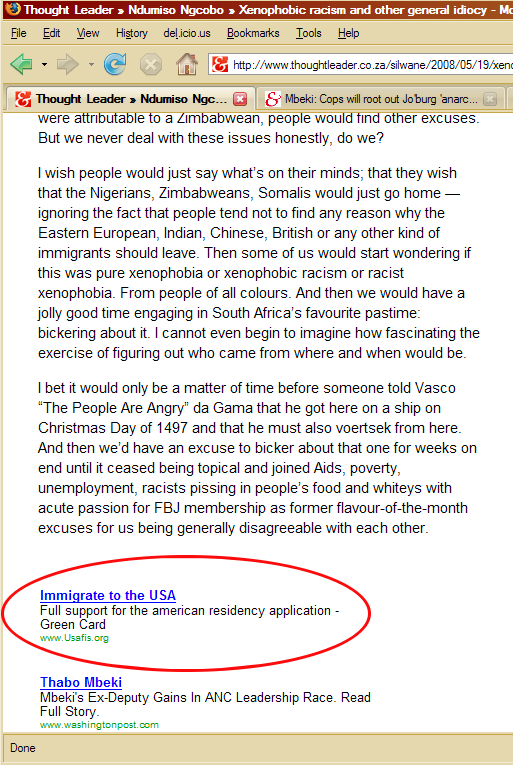
It seems Google Ads is suggesting that the refugees should have rather gone to the States, which is amusing on a number of levels considering the problems the States have with illegal immigration across their southern border.

What the hell is this? It doesn’t look like Bali-style architecture to me. It looks like more of that hideous faux-tuscan crap – now with Buddha! And doves of peace!
The horror is, these guys aren’t the first ones to come up with a Villa in the Pure Land (or perhaps, a villa that is the Pure Land).
Don’t get the wrong impression about my enthusiasm for e-book reader technology from this post’s title. I’m very excited about it, I just don’t think it’s going to take off unless a lot of things change. I’ve had my eye on e-book readers for a while. Alas, they don’t seem to make it across those vast oceans down here to the southern tip of Africa.
This is probably because they struggle to make much of an impression on the markets into which they are introduced. Africa only gets things imported to it once they’ve been proven in developed markets.
I’ve mentioned Sony’s reader in the past, and I linked to this New York Times article on it.
For your convenience I’ll summarise the NYTimes article.
This brings us to why I’m writing about this topic again. Lately I’ve been giving Thought Leader a look, and the blogs there are interesting and insightful.
I noticed that Eve Dmochowska wants a Kindle for Christmas, and I decided to throw some of my thoughts into the fray. I could’ve just posted a comment on that blog, but I have a lot to say and didn’t want to chase her readers away with a tedious monologue. Waffle Group readers know to expect danger when that “rambling waffle” category is used — I doubt Thought Leader reader are properly equipped for the monotony.
Kindle is what Amazon.com have recently brought out to compete with Sony’s e-reader. As Eve says, Kindle has potential because Amazon.com already have the connections with book publishers to more easily distribute popular e-book titles. Even more sneaky is the fact that a PC is not required to use Kindle. It has a wireless modem and can connect to EVDO/CDMA networks (provided such network connectivity is available — something she admits would be problematic in South Africa at the moment), and thus can directly download e-books from Amazon.com .
That last sentence is where my optimism about this technology whithers, while Eve’s is nourished. Forget the connectivity issue. Let’s assume that’s all sorted out, as it probably will be in the market where the product is first introduced (the USA).
Eve waxes lyrical about the technology liberating writers from the publishing-house stranglehold. No need to get a publisher to print your novel, just self-publish digitally and you have a simple, cost-effective distribution channel with no overheads for your work.
I totally agree with Eve and the industry shake-up this has the potential to cause, except…
E-books can be downloaded from Amazon.com. Only Amazon.com. And they come in a proprietary format that other e-book readers cannot read. The books are also encumbered with brain-dead DRM.
Certainly Kindle supports some other formats, so one isn’t actually completely reliant on Amazon.com for reading material. Unfortunately some of those formats can only be read on the Kindle if they are converted to Amazon’s format, and to do that you need to email them the document and they’ll email it back in the proprietary format — for a price.
Here’s the problem with proprietary formats and DRM: if this e-book reader thing actually takes off, and Apple brings out an iReader, I might want to ditch the Kindle and go with their uber-cool design and user-interface instead. Sadly I won’t be able to read any of the books I bought in Amazon’s locked file format. That’s the proprietary format issue. Why do these companies use their own secret formats when there is an open standard available? I’m not answering that.
The DRM issue is even worse. Amazon allows authors to upload documents which will be delivered to the Kindle via their Whispernet service. The author chooses the selling price, and Amazon keeps 65% of it. Anyone can publish, and Rick Aristotle Munarriz has tested the scenario that Eve suggests will promulgate itself across the publishing world.
Glorious! I wonder if the Kindle and Whispernet support publishing work under a Creative Commons licence? I doubt it. DRM and CC tend to be an anathema to one another. If you think people don’t publish novels under a Creative Commons licence and make a commercial success of it, think again. Cory Doctorow is an excellent example. I doubt he’ll be distributing via this channel until the DRM stuff is ditched.
If the music industry is anything to go by, DRM just damages sales figures. People get pissed off when you don’t let them do what they want with something they purchased, and irrespective of copyright law, believe that they own.
People who are going to conduct copyright infringement will do it regardless of DRM, because there are always technical work-arounds to this kind of tomfoolery. People who would legitimately have bought the products won’t, because they don’t want the crap and would rather go without music than deal with the idiocy of big corporations.
Digital distribution of music still works though, because the peer-to-peer networks and associated copyright infringement by sharing digital music became firmly entrenched before the recording industry caught on and instituted the DRM foolishness. Now the portable music playing devices are affordable. They may have been expensive when they were first released, but MP3s could be played on a PC too. The compressed format was established and one needed to only wait for the early adopters to buy enough MP3-players to drive the prices down.
This isn’t going to work with books. The DRM is in place first. The e-book reader is too expensive, but unlike music, e-book formats for dedicated e-book readers are not suitable for PCs and laptops. The people who buy the e-books and the readers are going to get annoyed with the DRM thing and the vendor lock-in, and tell their other earlier-adopter friends not to bother. Thus the price doesn’t go down. Thus another e-book reader fails.
I hope I’m completely wrong, because those e-book readers are nifty. I’m not sure they’re “sexy” though (a term Eve favoured in her post).
Seriously, have you seen a picture of these things? Sexy has more curves. 😉
At the end of our trip to Budapest we travelled a little out of the city to visit Memento Park (also called Szorborpark or Statue Park. Not called South Park, but they sold T-Shirts reading Marx Park and I bought one).
The Hungarians were clearly not all that impressed with the communist iconography and promptly stripped their city of all traces of it.
They weren’t angry though because, unlike effigies of Saddam Hussein during the er… “liberation” of Iraq, they didn’t get broken down and destroyed. Instead, they were simply taken down and deposited in a park outside the city.
The first few days in Budapest had magnificent weather. The day we visited Szorborpark was suitably glum and overcast. We couldn’t have timed it better if we religiously checked the forecasts at hourly intervals.
 |
 |
 |
 |
 |
 |
 The Waffle Group
