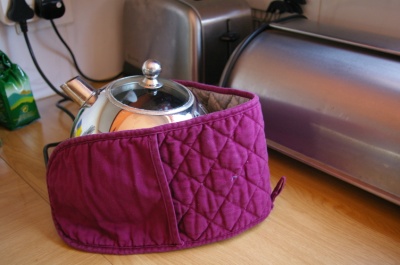
Dysfunctional Appliance

I have a larny chrome kettle. It’s shiny. It’s spiffy. It goes well with the other brushed steel appliances and containers in part of my kitchen.

It broke.

Dada-esque Kettle

Now, I’d like to say it was due to a design flaw, but that would probably be unfair to Mellaware. They do have a mark inside the kettle that indicates maximum water level. This guideline may have been ignored on several occasions by those in the family who embrace entropy, and all it’s associated chaotic effects, wholeheartedly.

Dada-esque Kettle

I suppose I should try to fix it. I’m uncertain though: does it need welding or soldering? And what effect will the heat have on the nice shiny bits. Will they be permanently tarnished? Will the kettle get all bent out of shape (literally).
At any rate, I don’t have the required equipment, nor the desire to own it. Suggestions on a permanent fix to this problem are welcome, but in no way urgent. I’m using the kettle as a kind of performance art piece now.

Dada-esque Kettle, with gloves

Metal kettles full of recently boiled water get hot. One cannot pick them up to fill the teapot without insulation. Perhaps I’ll get Angie to help me take an action shot of the Dadaesque performance art kettle in use.

Holidays in the Former Union of Soviet Socialist Republics

Today I was investigating interesting places to visit in Eastern Europe. The reasoning behind this is that Eastern Europe isn’t as orderly as Western Europe tends to be, and certainly not as orderly as Scandinavia is. Going to Europe seems to be something that we are investigating, but I’m damned if I’m only going to end up in London.
The other positive aspect of Eastern Europe is that it is likely to be substantially cheaper to spend a few days there — at least that’s what I’m led to believe.

Point is: I searched google for “best tourist destination eastern europe” and noticed that the 4th hit was this dubious gem.

Maybe I need to reassess whether or not the advantages of Eastern Europe outweigh the disadvantages.

Return to Goblin’s Cove

Easter weekend. Angie and I booked two nights (Saturday and Sunday) at Goblin’s Cove. We’ve been there before. It was weird then. It’s still weird. But we like weird.
(I also note that imageshack has eaten the photos on the page that links to. Stupid imageshack).

This time, however, there was a freaky crazy psycho woman running the psychedelic coffee-shop. She didn’t like bees.
The way she pulled her raven-black hair back made her look very severe.
The way she carried around a can of insecticide and a lighter made her seem a little crazed.
The way she used the flame from the lighter and the spray from the compressed can of insecticide made her seem a little pyromanic.
The way she incinerated the bees dispassionately made her seem evil.

Then she closed in on the table near us, where bees were happily investigating the sticky tablecloth. They weren’t bothering us. Psycho-woman was, especially as she waved the can and lighter about.
Angie asked her to please leave the bees alone. She replied that she wouldn’t possibly think of setting them alight near us. She went away, and at least those bees were spared — for the meantime.
As we sat at the table in the open-air coffee shop, situated in a pleasant, tranquil forest, we were unsettled by the just noticeable, slightly sweet, slightly charcoal smell of heavily crisped bees. That smell, and the occasional sound of localised pressure changes in the distance as the oxygen was sucked from the air to help form a bee-apocalyptic fireball.

Everything else was pleasant though.

One of the waiters at the main restaurant (not the coffee-shop) took quite a liking to us. We rather liked him too. There was an instantaneous rapport between us. After lunch (which ended relatively late) he suggested we come visit. After all, he lived on the property, just next door to the restaurant.
So a little later we wandered over and visited our new friend Wikus. He was staying in a house that was designed and built by the same guy who’d put the insane architecture together for the Goblin’s Cove restaurant. We had a look around. Up the spiral stairway. On the creaky, uneven wooden floorboards. Holding onto ropes, because there were no railings where there should’ve been. Incredible place to live.
Wikus told us he was a little paranoid about living there because it had massive windows and no burglar bars, and a not entirely secure front-door. Wikus is originally from Joburg. That should explain it all.
We spent quite a while sitting there, drinking with him, chatting, smoking. Talking politics, talking religion, talking history, talking relationships, talking shit. The restaurant’s cook came over for a little too. Jaco was his name, I think. Wikus and Jaco are both of the age where the big bad old apartheid government conscripted them. Wikus did his national service and then 6 months later, they scrapped it. He never went any place too intense. Nothing too crazy happened. He thinks Afrikaaner nationalism is a little ridiculous, and they kicked him out of F.W. de Klerk’s office (where he was going to be a staff clerk) because he’d been bust possessing marijuana.
Jaco went to Angola. Jaco fought in a war, for something he thought was justified. Jaco seemed like a really pleasant guy (he joined us for about 20 minutes or so, before going to bed). I quite liked him, and I really liked his cooking, but one could see a level of distress underlying the surface. Demons lurking there.
It made me think about who was helping these people. On both sides of the struggle. People who fought in wars and did things they’d never dream of doing today. Who is helping these souls? Or are they just left in torment for the rest of their lives, forgotten by society. The dirty laundry that no-one wants to face up to, let alone clean.

Getting intense. Unintentional. Still, it was an excellent weekend and we met interesting people and experienced interesting things. We exchanged contact details with Wikus. I really hope we don’t let inertia stop us connecting again.

Bring on the Gautrain! (but have it stop in every suburb in Joburg)

There is one major drawback of owning one car — you only have one car. This is, of course, also the major strength of owning one car.

This week, it’s proving to be a weakness.

While driving home via the N1 highway on Tuesday afternoon, the engine stopped working. I don’t really have the full details since Angie was driving. She really should be the one sharing this story, but we all know that is unlikely to happen. I’ll do my best.

The car cut out in the middle lane, and Angie came to a stop. Soon afterwards, I received a frantic phone-call from her, pleading with me to please help her. The car has stopped dead! People are hooting! I can’t get out of the car! Help me!
I wasn’t really sure what I was meant to do, considering that a) I was far from the scene, b) I had no way of easily reaching the scene, c) Even if I could get there quickly, I still wouldn’t be able to do anything.
I should’ve told her to phone the insurance people, but I faltered. Under pressure, I couldn’t really think of what to tell her to do. In the end I told her to phone 112 — the cellphone emergency number.
The problem was further exacerbated by the fact that I couldn’t keep Angie on the phone and try to calm her down because her cellphone battery was almost kaput. This left us with SMS communication. Clumsy and difficult. And confusing at times.

On the bright side, Angie had 15 seconds of fame as she made the 5FM traffic news (and probably other radio stations’ news too) for causing an obstruction on the N1, and slowing traffic.

Ultimately, a tow-truck arrived to transport Angie and the car home. The confusion of the SMSs played a part here. From our texted communication, I thought that the tow-truck had picked up the car and left Angie on the side of the road. Panicked, I phoned Quinn to ask him to give me a lift to fetch Angie (who I believed, was flapping at the side of the road — using words like “desperate” can give that impression).
By the time Quinn arrived, Angie texted me to say that the tow-truck had arrived and would be bringing her home soon.
Why I thought it had already made an appearance isn’t entirely clear to me now.

The truck brought the car home, to my slight dismay. Because we’d need to tow it somewhere else the next day — at additional expense. At which point Quinn brought to my attention that the insurance people should do it. At which point I felt foolish for having paid R500.00 to get it towed home.

The fun of the night was not yet complete.

By this point, it was about 18h30. Angie and I had intended to have pizza that night, and we were not intending on changing our plans. Kindly, Quinn dropped us off at the pizza place in our suburb. We ate the pizza, cursed our dismal luck with automobiles, and drank wine.
Then we walked home. At night. In Johannesburg. That’s right kids. It’s not really that scary. The pizza place is only about 1.5 kilometres from home.
Except…
As we got to the last corner before turning into our town-house complex, we encountered many agitated people on the road outside a house. And then one of the ADT security vehicles came flying by. We overheard the word “hijack.” The people looked at us as if we were strange circus beasts, or a rare species of bird — a breeding pair of the lesser-known white-skinned nocturnal pedestrian.

The fun of the night concluded there, but the fun of the car continues! Read on!

The truck was towed on Wednesday morning to a service station, where I was cheerfully informed that the cam-belt had snapped, bending all valves.
People with cars dread this happening. Fixing it involves replacing a bunch of stuff, and taking engines apart and so on. It apparently costs a lot because it takes a while to get everything done. I don’t really know for sure because I’m more of a geek than a mechanic. Which is why I get ripped-off by mechanics and not by PC sales-people. In hindsight, given the relative expense of purchasing and maintaining PCs versus motorcars, I should’ve taken more interest in mechanical operating systems, than in computer operating systems. At least from a financial perspective.
Further adding to my grief is the fact that the service station couldn’t source one of the spare parts before the end of today. It’s now the Easter weekend, which means I have no car until Tuesday.
We booked two nights at Goblin’s cove over the weekend.
Fortunately, Angie can abuse her position at her NGO and borrow the organisation’s car for the weekend. So, at least we are vaguely mobile once again.

These, and other unmentioned things, led me to return to get my hit of Buddhism on Wednesday. Something I’d been missing lately. One needs to attend classes regularly otherwise one forgets to keep doing those useful things that keeps one calm.

I’m keeping calm again, which is much better than the grumpiness I had been returning to.

Enough waffle — for now.

Translation Iteration — Super Special Edition

Do I have a treat for you! Not sure why I didn’t think of this before, but geeky people will understand.

English/Japanese Translation Iteration. Make your time.

All your base are belong to us. You have no chance to survive. Make your time

あなたの基盤はすべて私達に属するある。 存続するチャンスを有しない。 あなたの時間を作りなさい

Your basis belongs to us entirely, it is. The chance which continues the possession is not done. Make your time

あなたの基礎は私達に、それある完全に属する。 所有物を続けるチャンスは終らなかった。 あなたの時間を作りなさい

Your foundation belongs in us, completely that is. It did not end the chance which continues possession ones. Make your time

あなたの基礎は私達それで完全に、ある属する。 それは所有物を物続けるチャンスを終えなかった。 あなたの時間を作りなさい

Completely, there is your foundation with our that, it belongs. That did not finish the chance which possession ones the thing is continued. Make your time

完全に、私達ののあなたの基礎がそれのそれ属するある。 それは所有物が物事続くチャンスを終えなかった。 あなたの時間を作りなさい

Completely, your foundation our that of that belongs, it is. As for that possession ones phenomenon did not finish the chance which continues. Make your time

完全に、私達のそれの属するあなたの基礎、それはある。 その所有物に関しては物は現象続くチャンスを終えなかった。 あなたの時間を作りなさい

Completely, your foundation to which our that belongs, it is that. The thing phenomenon did not finish the chance which continues in regard to the possession ones. Make your time

完全に、私達のあなたの基礎属する、それをそれがある。 事現象は所有物に関して物を続けるチャンスを終えなかった。 あなたの時間を作りなさい

Completely, our your foundations it belongs, that it is that. Thing phenomenon did not finish the chance which continues the thing in regard to possession ones. Make your time

完全に、私達のあなたの基礎それはそれであること、属する。 事現象は所有物に関して事を物続けるチャンスを終えなかった。 あなたの時間を作りなさい

Completely, our your fundamental that belongs that being. Thing phenomenon did not finish the chance which thing the thing is continued in regard to possession ones. Make your time

Did Not Converge After 7 iterations, and is becoming less and less amusing, and more and more incoherent. At least “Make your time” translates perfectly.

As an extra treat for my readers, I think I’m finally bored of this so we’ll be returning to our usual programming.

Thank you for your patience.

Translation Iteration — Special Edition

That’s right. As not promised previously, the English/French/German iteration, because there is no French/Russian translation!

Sally sells seashells on the seashore. The shells she sells are seashore shells.

Sally vend des seashells sur le bord de la mer. Les coquilles qu’elle se vend sont des coquilles de bord de la mer.

Sally verkauft seashells auf dem Rand des Meeres. Die Schalen, die sie sich verkauft, sind Schalen des Randes des Meeres.

Sally sells seashells on the edge of the sea. The bowls, which them sell themselves, are bowls of the edge of the sea.

Sally vend des seashells sur le bord de la mer. Les cuvettes, qu’elles vente elles-mêmes, sont des cuvettes du bord de la mer.

Sally verkauft seashells auf dem Rand des Meeres. Die Schüsseln nur sie Verkauf selbst sind Schüsseln des Randes des Meeres.

Sally sells seashells on the edge of the sea. The dishes only them sales are dishes of the edge of the sea.

Sally vend des seashells sur le bord de la mer. Les plats seulement ils des ventes sont des plats du bord de la mer.

Sally verkauft seashells auf dem Rand des Meeres. Die Teller nur sie von den Verkäufen sind Teller des Randes des Meeres.

Sally sells seashells on the edge of the sea. The plates only them of the sales are plates of the edge of the sea.

Sally vend des seashells sur le bord de la mer. Les plats seulement ils des ventes sont des plats du bord de la mer.

Sally verkauft seashells auf dem Rand des Meeres. Die Teller nur sie von den Verkäufen sind Teller des Randes des Meeres.

Sally sells seashells on the edge of the sea. The plates only them of the sales are plates of the edge of the sea.

Converged.

I really wish there was a French/Russian translation. This nonsense of shells turning into various types of crockery is boring. I wanted guns to turn into all manner of carnage. Ah well. Back to work then.

Translation Iteration — Russian Edition

Courtesy of Google Translate

Today’s edition is somewhat more amusing than the French one, considering the English/Russian Russian/English translators are still in BETA.

Sally sells seashells on the seashore. The shells she sells are seashore shells.

Салли продает Дек.раковины на берегу моря. Орудий она продает побережья являются морские раковины.

Sally sells seashells on the seashore. Shells it sells off the shells.

Салли продает Дек.раковины на берегу моря. Корпуса продаются у орудий.

Sally sells seashells on the seashore. Shells sold the guns.

Салли продает Дек.раковины на берегу моря. Корпуса продаются ружья.

Sally sells seashells on the seashore. Shells sold shotguns.

Салли продает Дек.раковины на берегу моря. Корпуса продаются ружья.

Converged.

It seems that in America, Sally sells seashells; but in Soviet Russia, shells sell guns.

Forthcoming attraction — English/French/Russian Translation Iteration! Stay tuned!

Translation Iteration – French Edition

Courtesy of Google Translate

Sally sells seashells on the seashore. The shells she sells are seashore shells.

Sally vend des seashells sur le bord de la mer. Les coquilles qu’elle se vend sont des coquilles de bord de la mer.

Sally sells seashells one the seashore. The shells she sells are seashore shells. Sally sells seashells on the edge of the sea. The shells which it is sold are shells of edge of the sea.

Sally vend des seashells un le bord de la mer. Les coquilles qu’elle se vend sont des coquilles de bord de la mer. Sally vend des seashells sur le bord de la mer. Les coquilles qu’elle est vendu sont des coquilles du bord de la mer.

Sally sells seashells edge of the sea. The shells which it is sold are shells of edge of the sea. Sally sells seashells on the edge of the sea. The shells which it is sold are shells of the edge of the sea.

Sally vend le bord de seashells de la mer. Les coquilles qu’elle est vendu sont des coquilles du bord de la mer. Sally vend des seashells sur le bord de la mer. Les coquilles qu’elle est vendu sont des coquilles du bord de la mer.

Sally sells the edge of seashells of the sea. The shells which it is sold are shells of the edge of the sea. Sally sells seashells on the edge of the sea. The shells which it is sold are shells of the edge of the sea.

Sally vend le bord des seashells de la mer. Les coquilles qu’elle est vendu sont des coquilles du bord de la mer. Sally vend des seashells sur le bord de la mer. Les coquilles qu’elle est vendu sont des coquilles du bord de la mer.

Converged.