Tammy’s Wedding

I haven’t seen Tammy for ages. Distances separate us, and neither of us seem to try hard enough to bridge those gaps. She did invite me to her wedding though, but it’s telling that I hadn’t met the groom until the big day — 10 March, 2007.

Tammy looked exceptional, as brides generally do. It’s something about the whole energy of the event of a wedding. People are happy and excited and thrilled for the couple, and they just soak up all that positive energy and radiate it back out at everyone.

Tammy and Nic leaving the church

Tammy lives in Polokwane, in the Limpopo Province. I’m not entirely sure I’ve been to Limpopo before, but I really think I should’ve made an effort to get there before. It really is beautiful.

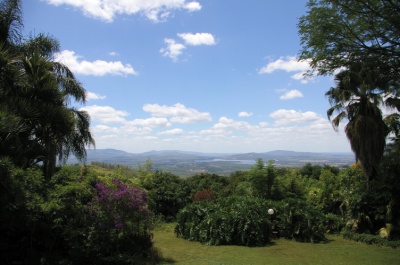
Limpopo had this whole marketing thing going down in Gauteng about “Limpopo — Africa’s Eden.” Sounds like the usual exaggerated marketing in your pants. Well, where we went for the wedding and reception, it seemed a reasonable assessment of the situation.

Africa’s Eden

Of course, the thing about a wedding is that you never really get an opportunity to speak at much length with the bride and groom. Things were no different in this case.

The cool thing was that a bunch of people who I knew from university travelled up from Cape Town for the wedding. Did some catching up with the UCT, predominantly chemical engineering, crowd.

Surprising things were discovered — Lisa is married. Sam is in a serious (I think) relationship he didn’t appear to be in the last time I saw him (which was quite a while back when I was torturing myself with post-graduate studies). Mareike is back in the country!

Egads!

Everyone — except MareikeAngie and Mareike

If only the first picture had Mareike in it! I really need to try to be a little less adverse to orchestrating the occasional posed, group photograph.

Sad

I have a happy exciting post to put up about Tammy’s wedding, but I think the bad news should come first, even though we found out about it second.

Angie’s granny (her father’s mother) suffered a stroke and was hospitalised on Sunday night.

Understandably, Angie is quite distressed about it. I’m trying to keep her from getting completely depressed. She’s doing okayish. She could be better, but she really could be a lot worse.

My information on Granny’s status is a little vague, so what I say here might be a little inaccurate. She has been moved from the high-intensive-care wards to the less-serious-but-not-good-condition wards. Indications at this point are that she’s probably going to get through this, but isn’t going to fully recover. She’s probably going to need a full-time nurse from now on.

I must reiterate that the details I have are a little fuzzy, and I haven’t been to visit her so all my info is 2nd hand. If you happen to be family, rather speak to Bill or Angie for more accurate information.

Here’s my wish for the best outcome for Angie’s granny — a proud and independent woman.

Angie and Granny

Chris Munton Photography

Due to a comment posted by Michael, I went to check out my wedding photographer’s website. I see he is now providing high resolution digital images on CD, as part of his wedding photo package.

I guess he’s doing this since he went digital. Back in 2003, he was still using film.

I’m mildly vexed (it really is mild, although vexation nonetheless) about this. When Angie and I contracted him for our wedding, we specifically requested a CD with all of the prints digitally. We even had to pay an extra R500.00 for the damned thing. I had assumed they would be high resolution images.

Ass U Me.

Project Update Time!

Haven’t updated the status of my numerous projects for a while, so I thought that I should.

What projects am I talking about? The structured procrastination projects, designed to make me an incredibly productive individual.

A quick overview of the tasks I set for myself:

  1. Office Work
  2. Office Admin
  3. Project A — write a novel, called “The Adventures of Commitment Man”
  4. Project B — write 100 word stories for friends and family, and give them as gifts
  5. Play chess online
  6. Blog everyday

And now an assessment of my progress in each category:

  1. Working consistently, most of the time. There are so many projects to do at the moment that there really isn’t any time to do non-work stuff during working hours (although, I am squeezing in this blog entry)
  2. Admin — not really happening independently of work. I think I shall simply lump this together with work from now on. Possibly, this reduces my structured procrastination capacity. But more on that a little later
  3. Hmm. Not going swimmingly.
    1. I’ve written an additional 1500 words or so since I conceived of this incredible plan to do stuff. A bit rubbish, really.
    2. On the plus side, I’ve started putting together a mind-map of the plot, characters, scene locations, and so forth. Things are getting a little complex and I decided I needed some sort of layout to help me keep things consistent
      1. Yes, this looks suspiciously like a sub-task to avoid actually writing the novel — but I’m convinced it’ll help get the novel written.
  4. Ah. Project B. It was going so well. Two batches written and distributed. Seven stories in total. Happy recipients. Those were the days.
    1. The family batch is waiting for me. It’s a big batch. 1 wife, 1 mother, 1 father, 2 brothers, 1 mother-in-law, 1 sister-in-law, 1 niece, 1 nephew. That’s nine stories. It feels like a lot, even though it’s only 900 words.
  5. Chess. Online. Not really happening.
  6. Blog everyday. Also not happening, but then I always knew that it wasn’t going to happen every day, so in view of that, this task is going quite well. Perhaps instead of blogging, I should focus on point 3 and 4 a little more. That’s what I really want to get done.

I also mentioned how I had been infected with dSLR attachments. So I went and splurged a little, and bought the Pentax K100D.

This allows me to add a task — 7. Take camera with me everywhere, and pretend to be a Japanese tourist.

Incidentally, I’m off to Limpopo this weekend for another wedding. Fortunately, I’m not the official wedding photographer this time — but I figure I’ll be taking a few shots of the festivities with ye newe acquisitione.

The Wedding Photograph Taker

Over a week has passed since Rob and Louise rammed shut the deadbolt, and threw away the key. The only way out now is the hacksaw of divorce, but I’m not expecting them to take such drastic measures. Those two were incredibly cheerful newly-weds.

There is more to this other than the fact that Rob and Louise are good friends, and Angie and I were pleased to be part of their wedding. Louise got a silly notion into her head that I know how to take photographs. Sure, everyone does.

  1. Point lens at subject.
  2. Press shutter-release button.
  3. Rinse and Repeat.

Louise, however, figured I do the above so well, that I should be the official wedding photographer. Who needs professionals, when you’ve got Neil?

How Neil was Tricked
I agreed to take photographs at the wedding some months before it was due to take place. It wasn’t clear at the time that I would be the photographer. Sneaky Louise. Sneaky.

Although I’m certainly no professional photographer, I do offer value for money. I didn’t charge for my time, and Louise and Rob still got some half-decent photos. Considering I took over 300, I suppose the stats were on my side that I’d get at least one good one.
Rob and Louise pulled the wedding off spectacularly on just a shoestring budget, so it’s understandable that they weren’t too keen to shell out 1000s of rands for a pro. That would’ve snapped the string.

How Neil Tricked the People into Thinking He Knew What He Was Doing
Normally, wedding photographers have big cameras. The bigger the camera, the more hardcore you appear to be. It’s kind of like porn-stars.
You see, it actually has absolutely nothing to do with talent or skill. It’s all in the impression you give.

Unfortunately, I’ve got a small lens.
So I borrowed Quinn’s. His is big.

This had the desired effect. Many people described my scurrying around the church and taking photos as very professional. People kept referring to me as “The Photographer.”
Even when I tried to insist that, no, I’m just the “photograph taker” and that the big camera was a deceptive device to hide my incompetence, the perception of my professionalism remained.

So, thanks again to Quinn for lending me his camera.
Curses to him too, because now I’m shopping for a DSLR, and they don’t come cheap. But they’re so much better, I just can’t go back to using a compact camera. Looks like I’m paying to enhance my assets, so the porn analogy holds.

So I Took The Photos, and Here are A Few

The bride and groom

Louise and Rob — the bride and groom.

The Dress and the Designer
Roman, who designed and made the dress, and Louise, who wore the dress

leaving church

After signing the registry, Rob and Louise left the church.

The Nature of Money a.k.a. I might be a commie

Dave (that’s Crazy Dave to some, but he’s not really crazy at all — he just pretends) sent me an interesting link the other day. It led me to the Open Money Manifesto.
If you find the manifesto a little heavy reading, try the motivational material for playing the open money simulation game.

Now, describing money as “open” is something that immediately grabs my interest, and runs off with it in a work-avoidance spree of work-hours inefficiency. This is because I like to think of myself as a minor advocate for open source software. It could be described as software socialism — or Buddhism for software (the corollary of open-source software for your brain). But I digress.

That whole lot got me looking into this concept of “community currency.” The community creates its own money for use within the community.
You don’t need any money to begin trading — the money is automatically created when the trade takes place. So someone get debited, and the other party to the transaction gets credited.
The “money” is really just information keeping track of who has traded, and how much.
The money doesn’t ever leave the community. This is what normally happens in today’s economy, resulting in extreme poverty in some areas, and extreme wealth in others — and the wealth is always flowing from the poor to the rich areas. This community currency thing stops that happening.

Those are just a couple of points. Read the linked articles for a better description.

On some investigation I discovered that such a network exists in South Africa. Check out the South African New Economics Network and its Community Exchange System for more info.

Some intriguing questions are raised by this system:
If everyone trades in the community currency, and thus never makes profit or actually earns anything, how happy will the tax-man be?
Can you inherit community currency (cc) from a deceased relative, even if you aren’t a member of the particular community?
Since one can start trading before having any credit, what measures are taken to prevent unscrupulous members of the community buying many goods and services, and then simply buggering off? They do mention something about this in the articles, but I think there may be more avenues for fraud here that haven’t been considered.

There we go kids.

Open Source. Open Religion. Open Money.

A co-operative society is the best way. Everyone shares everything — money, views, ideas, time, labour — and is tolerant of others.

What a nice place Utopia Land is.

Illovo in your pants thwarted

I had some old sugar with Illovo’s marketing slogan written on the packaging — Everybody loves Illovo (in your pants!).

“Excellent!” I thought to myself, rubbing my hands together in a sly, devious fashion.

To my dismay, everybody no longer loves Illovo. Illovo have slightly re-factored their target market:

illovo igrand in my ipants!

The pod splashed down safely in the Pacific

I’m back on Earth now.

Audit Fun in Sishen
The week in Sishen has been elucidating, and, as you are already aware — red.
I know a lot more about environmental auditing now. I also know a lot more about Sishen Iron Ore Mine. Although I know more, this must not be mistaken with me knowing much. That mine is massive, and 5 days to look around only gets the dust of knowledge under one’s nail.
I’d probably have to stay there 2 years before the dust of knowledge coated me as thickly as the physical dust of iron ore did in the 5 days of my visit.

I just washed my clothes, and it seems I’m going to have to get used to a red undertone in the denim. Ah well.

But what does Mars actually look like?

Mars looks like that pit. Doesn’t really seem that big, does it? Well, here’s something to give you a little perspective on it all. Those three little blotchy bits in the middle are haulpacks. They are the massive 250 ton trucks that move the iron ore from the pits to the stockpiles, and from the stockpiles to the primary crusher.

They don’t really look like much there, but they are big yellow (at least, initially yellow) trucks. The little people seen maintaining them in the following two photos are, in fact, normal-sized people. Thus, the trucks are enormous. Thus, the pit is bigger than enormous. I can’t think of a word for that at the moment. I’ll make one up instead — the pit is gigabig.

In conclusion, the place is big and red, as is everything in it (this includes quite a few of the people, although results may vary). I may be repeating myself on this, but I don’t believe it is possible to over-emphasise the importance of the bigness and redness of Sishen Iron Ore Mine.

That’s not all. For your viewing pleasure I also present an image of part of the mostly decommissioned south plant. When the mine started the crushing and screening plant was here.
All that is left is the reinforced concrete skeleton of the place. It was a little like I’d found evidence of the lost civilisation of Mars. Of course, that wasn’t really the case. If I’d really found a Martian civilisation, then I’d find evidence of intelligent extra-terrestrial life. All there seemed to be around Sishen were miners [1].

I don’t think that I can really go into the details of the audit (and I’m thinking even these photos might be iffy, but I don’t think I’m really giving very much away that isn’t public knowledge anyway), so I’ll move on to the difficulties of leading a vegetarian lifestyle in the Kalahari.

The Difficulties of Leading a Vegetarian Lifestyle in the Kalahari
I stayed at the Cranberry Cottage, a B&B in the town of Kathu, just a few kilometres from the mine. It’s a really lovely place to stay if you happen to be passing through that way for some reason or another. I really liked it there. The hospitality was traditionally Afrikaans, and the people were extremely friendly, even to Engelsmanne like my colleague and me. But then we threw them a curve-ball: Could they cater for a vegetarian?

Puzzled looks. Very puzzled. Cranberry Cottage is a family run business, and so the members of the family really care about the service and experience they provide to their guests. I really felt for Magda Fourie as she tried to get her head around this concept of me not wanting to eat any meat.
“Vegetarian?” she asked, “Will you eat chicken?”
“Uh…” I said, but not wanting to distress her, but my facial expression must have been skeptical.
“Fish?” she ventured.
Hesitantly, I agreed that fish would be an acceptable “vegetarian” meal. That evening, for dinner, they made me an especially prepared chicken potjie. By not digging too deep into the stew-pot, I managed to avoid most of the chicken and feasted on the included vegetables.

There was a rerun of this on another of the days where we negotiated for fried fish as my vegetarian meal, and I received braaied chicken. Crispy. Charred. Very much a dead animal. Not wanting to offend my hosts and their efforts to provide me with a vegetarian meal, I struggled through the chicken, eventually giving a third of it to my colleague who’d already polished off a T-bone steak.

But hey, as Magda told me one of the evenings, “In the Kalahari, chicken is a vegetable.”

The guest house wasn’t the only place where I was met with general confusion regarding my lifestyle choices. The guys we dealt with on the mine were also perplexed, although whoever did the catering at the mine seemed to understand what vegetarian meant. I was provided with a Greek salad for lunch once I’d let them know of my meal preferences. No chicken or fish in sight. Unfortunately there was also no originality in sight. While everyone else was provided with a different meaty dish each day, I got my trusty Greek salad, three days running.

One of the people we dealt with assumed I must be on a diet. I think the other guy assumed I was crazy. Every time I ate my salad he made some comment about it. Eventually I got a little annoyed and asked him why he didn’t eat his tortoise (which he’d rescued and nursed back to health after being run-over) or his pet dog. We concluded that he only eats animals he hasn’t taken the time to get to know. I let my follow-up question slide. Why doesn’t he eat people he hasn’t yet got to know?

[1] And they were very nice miners. If you are one of those people who likes to perpetuate stereotypes, you might choose to interpret this comment as implying that miners are not intelligent. However, there are a number of interpretations of the statement available to our intrepid reader. Examples; Miners are not alien lifeforms, Miners are not intelligent aliens, There are only miners in Sishen and no aliens, The Holy Grail is buried at Sishen, The winning lottery numbers are 8 13 27 32 38 44
The interpretation is entirely up to you